The Reinvention of an Icon: Inside the Birth of the First‑Generation MINI
For more than four decades, the classic Mini buzzed along Britain’s roads with a kind of effortless charm. It was never just a car; it was a cultural artefact, a rolling reminder of Alec Issigonis’ genius. Yet as the years ticked by, one question loomed larger than any other: what could possibly follow it?
Attempts had been made. Issigonis himself toyed with the 9X in the late ’60s, and British Leyland’s ADO74 and ADO88 experiments eventually spawned the Metro. But after that, the trail went cold. Through the 1980s the Mini drifted, beloved but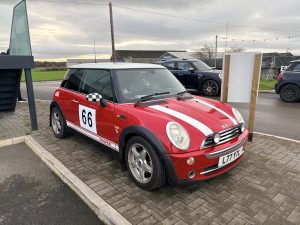 ageing, until a surprising revival in the 1990s—fuelled by Japanese enthusiasm and the reborn Mini Cooper—proved the little car still had magic left in it. When BMW bought Rover in 1994, it saw what others had missed: the Mini wasn’t just a model. It was a brand with untapped potential.
BMW’s chairman, Bernd Pischetsrieder, wasted no time. He pushed Rover’s British designers to imagine a new Mini for a new era. Meanwhile, in Munich, an American-born designer named Frank Stephenson was sketching his own vision. Two teams, two philosophies, one legendary name at stake.
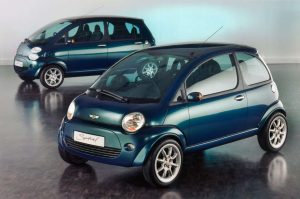
Their showdown came in 1995. Rover’s proposal, Spiritual, was a radical rethink—rear-mounted engine, rear-wheel drive, and a clean-sheet approach that owed little to the original. A larger sibling, Spiritual Too, hinted at a whole family of future Minis. BMW’s concepts, by contrast, were more evolutionary, more recognisably Mini. Rover refined its ideas through the winter, but in 1996 BMW made the call: Stephenson’s design would lead the way. Rover would engineer it, and the project—once E50—became R50. The “R” still stood for Rover, even as the sands were shifting beneath the company.
The Spiritual concepts resurfaced in 1997 through carefully orchestrated leaks, stoking public curiosity. BMW added to the intrigue with the ACV30, a two-seat concept celebrating the Mini’s final Monte Carlo Rally win. 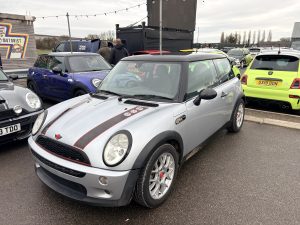 But the real moment came that September at the Frankfurt Motor Show, when the R50 broke cover. The car on display was little more than a beautifully crafted illusion—a skin draped over a modified Fiat Punto platform—but it was enough to ignite imaginations.
Behind the scenes, the real engineering was taking shape. BMW had abandoned plans for its own engine and dismissed the Rover K-Series as too bulky, so a joint venture with Chrysler produced the 1.6‑litre W10 “Tritec” engine. Proper prototypes hit the road in late 1997. But corporate upheaval slowed everything: Rover was sold to the Phoenix consortium, BMW kept the MINI brand, and production moved from Longbridge to Cowley. The world would have to wait.
The last classic Mini rolled off the Longbridge line on 4 October 2000. Nine months later, on 7 July 2001, MINI dealerships opened across the UK. The reborn MINI arrived in two forms: the 90bhp One and the 115bhp Cooper. Both carried the Tritec engine, both wore styling that was cheeky yet respectful, and both benefitted from BMW’s build quality and safety standards. The TLC servicing package—five years or 50,000 miles, transferable—sweetened the deal. The “It’s a MINI Adventure” campaign did the rest. Waiting lists grew. Used cars sold for more than new ones. The Mini was cool again.
The Cooper’s sharp steering and playful handling made it a favourite, even if its performance was more wa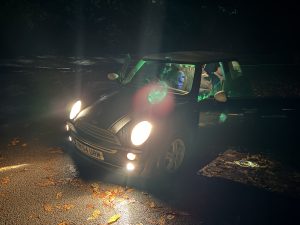 rm hatch than hot. A factory-approved John Cooper Works kit added spice, but the real firepower arrived in 2002 with the R53 Cooper S. Its Eaton M45 supercharger and Getrag six-speed gearbox transformed the Tritec engine into something genuinely exciting: 163bhp, 0–60mph in 7.2 seconds, and a 135mph top speed. It also marked MINI’s triumphant return to the US market.
The range expanded quickly. In 2003 came the frugal One D diesel and the official JCW kit for the Cooper S, pushing power to 200bhp. In 2004, the R52 Convertible joined the line-up, accompanied by a facelift across the range—new bumpers, updated lighting, fresh options, and a stronger Getrag five-speed gearbox for the One and Cooper. The Cooper S gained 170bhp and an optional limited-slip differential. The JCW kit climbed to 210bhp with revised injectors and a new airbox.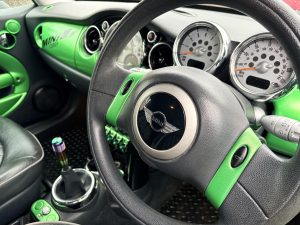
By 2005, the Cooper S finally received a proper six-speed automatic, replacing the CVT used elsewhere. The One D gained a modest power bump to 88bhp but kept its pre-facelift looks.
Special editions followed in 2006—Seven, Park Lane, Checkmate—each adding its own flavour. But the true finale was the MINI GP: a lighter, more focused, two-seat special built by Bertone, wearing unique aero, uprated JCW brakes, and distinctive four-spoke alloys. Painted Thunder Blue with a Pure Silver roof, priced at £22,000, and sold out before it even reached showrooms, the GP became an instant collectible. By the time production ended in 2006, 130,000 first-generation MINIs had been sold in the UK alone.
As a premium small car, the R50 MINI offered a dizzying options list. The Salt and Pepper packs bundled popular extras for the MINI One, while the Cooper added the Pepper pack as standard and offered the Chili pack for more premium wheels and tyres. The Cooper S had its own Chili pack, complete with xenons and half-leather trim. Fully loaded, a Cooper S could nudge past £25,000—a far cry from the humble Issigonis original, yet unmistakably part of the same lineage.
The first-generation MINI didn’t just replace a legend. It reinvented it—respectfully, boldly, and with just enough mischief to make Issigonis smile.